Ab Toning Belts: An Honest UK Guide to EMS, Safety and Expectations
What an EMS ab toning belt can and cannot do, who should seek medical advice, how to use one cautiously and which UK buying checks matter.
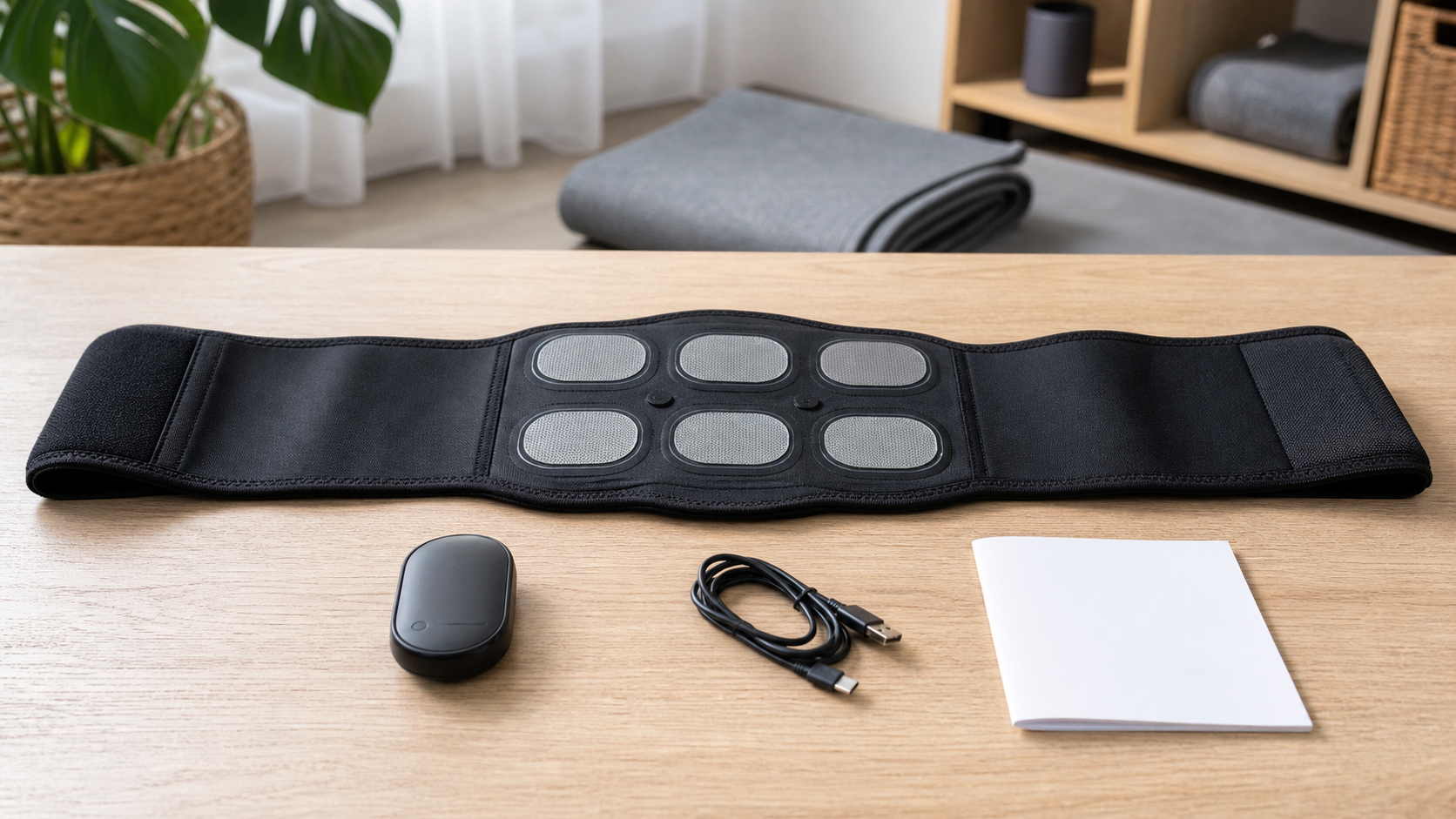
An ab toning belt uses electrical muscle stimulation (EMS) to trigger contractions through skin electrodes. It may provide a convenient muscle-stimulation session, but it does not selectively remove abdominal fat and it is not a substitute for exercise, nutrition, physiotherapy or medical care. Buy one only when the instructions, safety exclusions, pad system and returns route are clear.
What an EMS belt actually does
Electrodes deliver controlled electrical pulses through the skin. When contact is good and intensity is sufficient, the abdominal muscles contract. The sensation should be strong but tolerable, not sharp, burning or painful.
That mechanism explains both the possible value and the limit. The belt can make muscles contract; it cannot choose where the body loses fat. Visible abdominal definition depends on many factors beyond one local muscle group.
Claims such as “effortless six-pack”, guaranteed centimetres lost or a fixed percentage increase deserve caution unless they are tied to a named device, a relevant study and the same usage conditions. Evidence about clinical stimulation or rehabilitation does not automatically prove the marketing outcome of every consumer belt.
Who is an ab toning belt for?
It may suit a healthy adult who understands the limitations and wants a structured, repeatable core-stimulation session alongside normal activity. Heat, if present, may feel comfortable, but comfort is not proof of fat loss or treatment.
It is a poor fit for someone who expects passive weight loss, wants to treat pain or disease without clinical advice, cannot inspect the skin, or has a condition or implanted device covered by the manufacturer’s exclusions.
Check medical and safety exclusions first
The exact manual controls. Do not rely on a comparison article to replace it. Seek medical advice before use if you are pregnant, have an implanted electronic device, epilepsy, a heart condition, reduced sensation, a recent operation, unexplained abdominal symptoms or another relevant medical condition.
Do not place electrodes over broken, infected or irritated skin. Do not use the belt across the chest, neck or head. Stop if you experience pain, burning, persistent redness, dizziness or an unexpected reaction.
If a product is marketed for a medical purpose, UK medical-device requirements and markings may apply. The MHRA explains that regulatory marking does not make a device risk-free and advises users to follow instructions, maintain the device and report safety problems. A fitness accessory should not borrow medical authority through vague language.
EMS belt, heated belt and lifting belt are different products
These categories are often mixed together:
| Product | Main purpose | What it does not prove |
|---|---|---|
| EMS ab belt | electrically stimulates abdominal contractions | targeted fat loss or medical treatment |
| Heated EMS belt | combines stimulation with local warmth | that heat improves muscle-building outcomes |
| Heat-only wrap | provides warmth and comfort | muscle stimulation |
| Weightlifting belt | supports bracing during loaded lifts | passive abdominal training |
Buy for the mechanism you actually want. A heat feature can change comfort and skin risk, while a lifting belt is used in an entirely different context.
Eight buying checks
1. Clear intensity control
You need a visible way to start low, increase gradually and stop immediately. A large number of levels is less important than predictable control.
2. Session timer and automatic stop
A defined session helps prevent accidental overuse. Confirm whether the device stops automatically and whether heat and EMS have separate controls.
3. Electrode and pad system
Check whether pads need gel, how they are cleaned, how often they are replaced and what replacements cost. Poor contact can make stimulation uneven and uncomfortable.
4. Fit range
The conductive areas must sit flat over the intended muscles. A belt that curls, slips or concentrates pressure will not be rescued by higher intensity.
5. Heat controls
If heat is included, confirm the number of settings, independent operation and shutdown behaviour. More heat is not more effective. Skin comfort is the limit.
6. Charging and battery information
Use the specified charger and cable. Stop using a damaged, swollen or overheating battery. Confirm whether the belt can be used while charging; if the manual is silent, do not do it.
7. Instructions, markings and seller identity
Look for readable English instructions, manufacturer or responsible-person details, safety exclusions and the appropriate product markings for how it is sold. A printed logo alone is not a clinical endorsement.
8. Returns and replacement support
Skin-contact products can have hygiene conditions, so read the policy before opening consumable pads. Confirm the warranty and availability of replacement parts.
The current Tulilutele heated EMS belt page should be used for the present specification, included items, warranty and checkout price. If another page shows conflicting numbers, ask the seller to confirm in writing.
A cautious first-session protocol
- Read the complete manual and exclusions.
- Charge the controller as instructed and inspect the belt, cable and pads.
- Clean and dry the skin; do not apply lotion beneath electrodes.
- Fit the belt so every contact area lies flat.
- Start with heat off and the lowest EMS intensity.
- Increase only until contractions are clear and comfortable.
- Stay within the stated session duration.
- Remove the belt, inspect the skin and clean or store the pads as directed.
For a heated model, learn the lowest heat setting in a separate short session before combining it with EMS. Do not sleep in the belt, use it while driving or hide persistent discomfort by reducing attention to the skin.
What progress should you record?
Avoid staged “before and after” expectations. A useful log records:
- date, programme, intensity and session length;
- whether contact remained even;
- skin condition immediately and later;
- whether abdominal contractions felt controlled;
- any normal exercise performed separately;
- reasons for stopping or skipping a session.
This helps judge consistency and tolerability. It does not convert a home fitness accessory into a diagnostic tool or prove fat loss.
How to assess marketing claims
For each claim, ask four questions:
- Is the evidence about the exact device or only EMS in general?
- Were participants also exercising or changing diet?
- Was the outcome strength, endurance, waist measurement, body fat or appearance?
- Is the result presented as an average with limits, or as a guarantee?
An honest product page separates muscle stimulation from weight-loss claims and names uncertainties. Treat testimonials, star badges and dramatic photographs as marketing unless their provenance can be checked.
Common mistakes
- Turning intensity to maximum on the first day.
- Using dry, worn or badly positioned pads.
- Assuming tingling or pain means the session is more effective.
- Combining high heat and high stimulation before testing either one.
- Reusing damaged cables or swollen batteries.
- Treating EMS as a replacement for movement, diet or prescribed rehabilitation.
- Using the device despite a manual exclusion.
- Quoting old prices, warranties or study percentages as current product facts.
For more background, read the EMS ab belt guide. Review hygiene conditions and timing on the returns policy before a full trial.
Frequently asked questions
Do ab toning belts burn belly fat?
An EMS belt stimulates muscle contractions. It does not selectively remove fat from the abdomen. Body-fat change depends on wider energy balance and activity.
Can I use an EMS belt every day?
Follow the exact product instructions. More frequent or longer use is not automatically better. Stop for pain, burning or persistent skin irritation and seek advice when needed.
Is stronger intensity more effective?
The useful setting creates clear, tolerable contractions with even pad contact. Painful intensity can irritate skin or make the session unsafe and inconsistent.
Are heated EMS belts better?
Heat can change comfort, but it does not prove better toning or fat loss. It also adds temperature and skin-safety considerations. Judge heat and EMS separately.
Can I use a belt with a pacemaker or during pregnancy?
Do not use it unless the manufacturer and an appropriate healthcare professional explicitly advise that it is safe for your circumstances. Implanted electronic devices and pregnancy are common exclusions.
What should I do if the skin stays red?
Stop using the device, inspect and replace worn pads, and follow the manual. Seek medical advice if irritation persists or is severe.
Bottom line
An ab toning belt is a muscle-stimulation tool, not a passive weight-loss machine. The best purchase has clear controls, honest claims, available pads, complete safety instructions and a workable returns route. Start low, keep contact even, record skin response and stop whenever the experience moves from strong contraction to pain or burning.